

Phoenix, AZ · What we treat
Shoulder Pain in Phoenix
Reaching into the back seat, sleeping on that side, the top shelf: shoulder pain shows up in ordinary moments. We find which structure is irritated and which one stopped doing its job.
Why does shoulder pain happen?
The shoulder is your most mobile joint, so muscles do the stabilizing work that bone does elsewhere. Pain starts when that trade goes wrong, from an injury or gradually through posture, repetitive movement, or muscle imbalance.
- Rotator cuff irritation. Four small muscles keep the ball centered while the big ones move the arm. An overworked or underpowered cuff tendon takes load it was not built for, causing night pain and a painful first reach of the morning. These tendons can also be strained or torn.
- Impingement under the acromion. If the shoulder blade does not rotate as the arm rises, tissue above the cuff is compressed in a narrow band of the arc: it hurts from here to here, then eases. The bursa cushioning that space can also become inflamed, which is bursitis.
- Instability. The ball moves more in the socket than it should, usually after a dislocation or in naturally loose joints, so the arm feels unreliable at end range. A labral tear, damage to the socket’s cartilage rim, can do the same.
- A capsule that has tightened. In a frozen shoulder the capsule thickens and shrinks, and reaching behind your back goes first. It runs in phases, and the dose has to match the phase. Arthritis also limits range, with pain and stiffness from degenerative change.
- A repair that healed but was never rebuilt. After surgery the tissue heals on schedule, but strength does not return on its own. Stop care once it is comfortable and the shoulder stays unconvincing overhead. Competitive swimmers notice it first, late in a set.
None of these are diagnosed by pressing on the sore spot. The evaluation watches the arm move under load, compares active and assisted range, tests strength at the angles you need, and screens mobility, nerves, and posture.
How shoulder pain gets described out loud.
-
Usuallythe cuff tendons are compressed when you lie on them, so night pain is often the first sign of irritation.
Why does this happen ⟶ -
Usuallythe ball is not staying centered in the socket as the arm rises, so tissue gets pinched at a predictable point.
Why does this happen ⟶ -
Usuallythe joint capsule has tightened, limiting the arm equally whether you lift it or someone else does.
Why does this happen ⟶
Most people have already tried band exercises. They want someone to watch the arm move, find the part that breaks down, and explain why.
How do we treat shoulder pain in Phoenix?
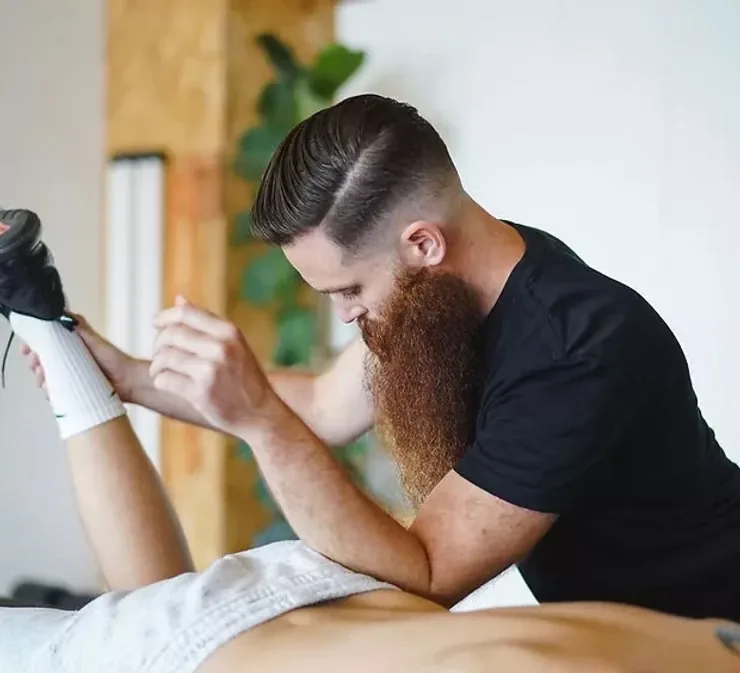
Every visit is 60 minutes, one-on-one with the same Doctor of Physical Therapy. The first is a cause-first evaluation, hands-on treatment starts that day, and you leave with a plan and a named endpoint.
No referral is needed in Arizona. We are cash-pay and do not bill insurance directly. Care usually runs two to three visits a week for at least four to six weeks.
What does getting better look like?
Sleep usually improves first, often within a week or two. It means the irritation is coming down, not that the problem is over.
Range returns next, overhead before behind the back. Strength comes last and decides whether this stays fixed: a comfortable but weak shoulder flares the next time you paint a ceiling or start a training block.
Left alone, an irritated shoulder teaches you to stop using it, and avoided range becomes lost range. If pain has lasted more than two weeks, worsens with movement, or limits lifting, reaching, or sleep, get it evaluated.
Most shoulder conditions respond well to conservative care, and starting early can help you avoid injections or surgery. If yours needs imaging or a surgical opinion, you will be told. Non-operative and post-operative shoulder care is a focus of Dr. Nick Hadinger’s practice.
Get the tendon out of the pinch.
Joint mobilization, soft tissue and trigger point work at the shoulder, shoulder blade, neck, and arm, dry needling where guarding limits you, and a few positions to avoid for now. Sleep usually improves first.
Give the shoulder blade its range back.
Mobility where you are actually limited, usually the upper back and capsule rather than the sore spot. If pain runs into your neck, we treat that too, since trapezius tension often links the two.
Load the cuff at the angles you avoid.
Progressive rotator cuff strengthening and scapular stabilization through the arc you avoid. Overhead returns in steps, chest height, forehead height, then above, each cleared by a standard, not the calendar.
Test it before you trust it.
Side-to-side strength testing and a return check against your real demand, from a barbell overhead to lifting a grandchild. Then a program sized to your week, plus ergonomic changes for work and daily tasks.
Start with a cause-first evaluation for your shoulder.
Put it in writing.
Five short questions. A real person calls you back, usually within two business hours, with times that fit your week.
The people who end up filling this out are rarely in the worst pain of their life. They’re just done working around it, done picking the errand that doesn’t require the stairs. If that’s the stage you’re at, this is the part where you stop researching and start.
Consider it filed.
A real person will call you back, usually within two business hours, with appointment times that fit your week. Keep your phone nearby.
Can’t wait? Call (602) 755-3138 ⟶Easy to find. Easy to park.
In the neighborhood, with parking by the door. Come see the place before you commit, if you like.
The clinic · Streamline Performance Physical Therapy
Get Directions ⟶Opens in Google Maps