

Phoenix, AZ · What we treat
Pelvic Floor Dysfunction in Phoenix
Leaking, urgency, heaviness, pain with sitting or sex: pelvic floor symptoms are common and treatable, not something to accept after a baby or at fifty. First we find out whether your floor is weak or working too hard.
Why does pelvic floor dysfunction happen?
Two opposite problems produce nearly identical symptoms, so the same home advice helps one person and worsens the next.
- Weakness and poor endurance. The muscles cannot produce or hold enough force to close the urethra when pressure spikes. Real, but only about half of what we see.
- Over-activity and guarding. The other half: muscles that never fully release, and a short, tense muscle also tests weak. More squeezing makes it worse, which is why home Kegel programs often fail.
- Coordination rather than capacity. The floor must release to empty and contract to hold, on cue. When timing reverses, you strain to empty and leak to hold despite decent strength.
- Pressure management through the trunk. The floor is the bottom of a pressurized canister with the diaphragm on top. Breath-holding, a rigid rib cage or a poorly modulating abdominal wall sends force straight down, so breathing and lifting technique belong in the plan.
- Delivery, surgery, and years of load. Vaginal delivery, cesarean, hysterectomy, prostate removal, hernia repair, chronic constipation, a long-standing cough, heavy lifting, high-impact sport, aging and some medical conditions all change how the floor tolerates pressure. Common is not normal, or permanent.
The evaluation tells you which you have: an over-active floor gets manual work, down-training and breath mechanics first; a weak floor gets graded load. Get that fork wrong and you do the wrong homework for years.
What pelvic floor dysfunction sounds like out loud.
-
Usuallyan over-active floor, where more squeezing is the wrong direction and the muscle must learn to let go before it can hold.
Why does this happen ⟶ -
Usuallyclosure that is not happening at the right moment, far more often a timing and pressure problem than a strength problem.
Why does this happen ⟶ -
Usuallypelvic muscles holding a low-level clench all day, like a jaw, which shows up as aching, burning and pain with penetration.
Why does this happen ⟶
Up to a quarter of adults have pelvic floor dysfunction: problems with the muscles that support the bladder, bowel and pelvic organs and control holding and releasing. It can also mean constipation, straining, incomplete emptying, reduced sensation or unexplained lower back pain.
How do we treat pelvic floor dysfunction in Phoenix?
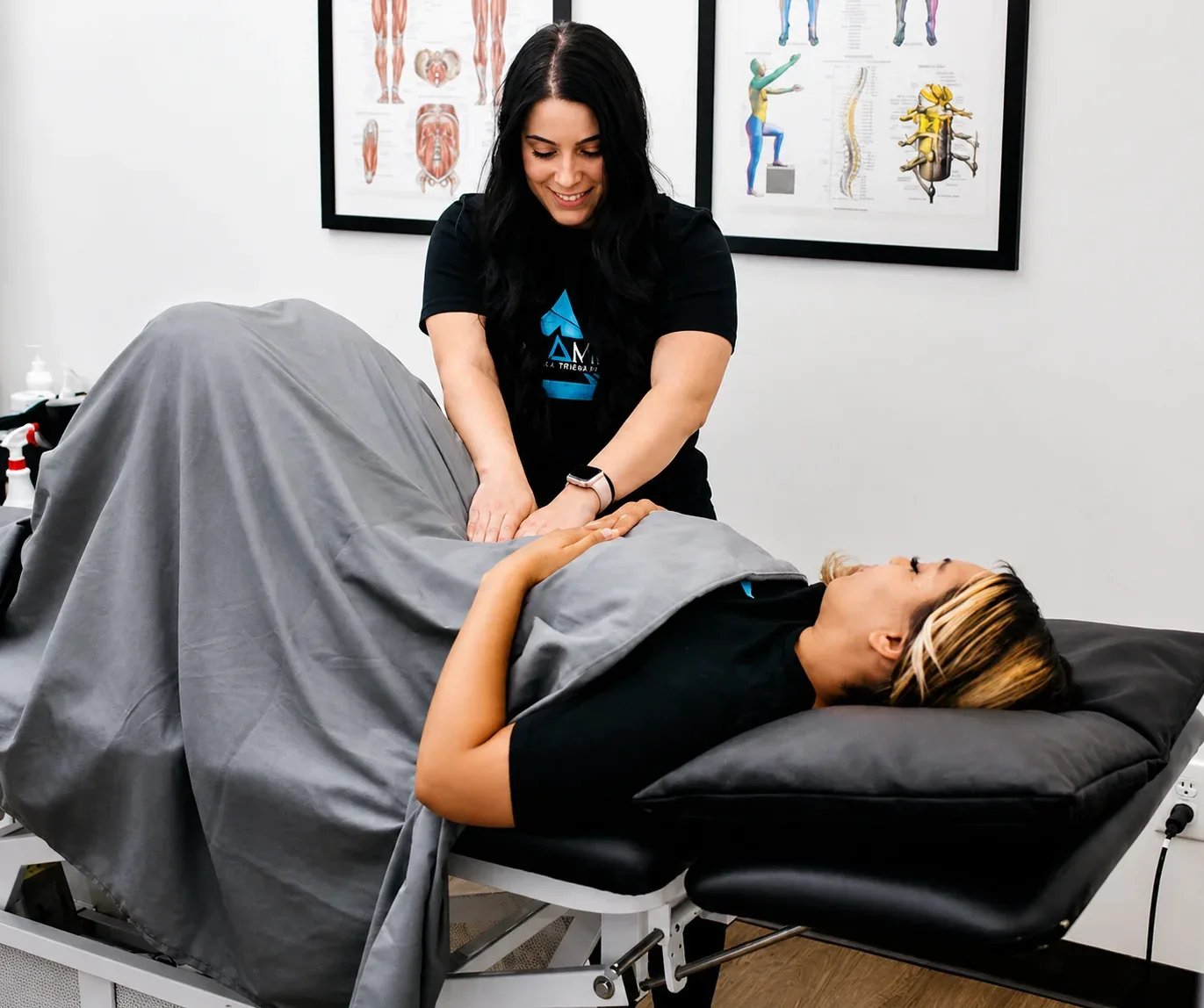
You see Dr. Krista Zelizney (Female Pelvic Floor L1, 2a and 2b) or Dr. Jake Lape (Male Pelvic Floor Therapist), one-on-one, every visit, in a private room. Men are a real share of the caseload.
The first visit is a cause-first evaluation of history, breathing, trunk and hip strength, pressure management and the pelvic floor. Any internal assessment is explained first and needs your consent. Plans have a named endpoint, typically 2 to 3 visits a week for 4 to 6 weeks minimum; no referral is needed in Arizona.
What does getting better look like?
Most people have already tried the app, the six-week-check handout and years of squeezing at red lights. They want to know which problem they have, told plainly.
Some notice change within a few sessions; most see significant progress within 6 to 8 weeks, depending on severity and home program consistency. Leaking on every sneeze becomes some; the sitting ache arrives later, then stops. Those are the markers we track.
Left alone, it rarely holds still. The pad becomes routine, the trampoline and heavy set quietly disappear, and the workaround stops registering as a symptom.
Some symptoms need a physician first: blood in urine or stool, new or sudden loss of bowel or bladder control, fever with pelvic pain, or unexplained weight loss.
Take the guarding down.
Hands-on treatment starts at the evaluation: manual work, positional release and genuine downward relaxation for an over-active floor, or calming an irritated bladder with bladder and bowel training first.
Restore the range and the breath.
Full lengthening before full shortening. Posture, hips, ribs and diaphragm are treated with the floor, since a floor that cannot descend on an inhale will not contract well on an exhale. Biofeedback shows the muscle in real time.
Load it the way your week does.
Progressive strength for floor, hips and trunk, against standards you clear, toward the exact cough, lift, jump or toddler on one hip that leaks or aches.
Make it stay fixed.
Testing before clearance, a short program that fits your week, and a plan if a symptom returns.
“When I hurt my back, I started seeing Krista regularly for a couple months. She’s more than just a physical therapist, she’s a friend who really cares. I ignorantly turned a blind eye to the importance of core strength, and by working with Krista, I saw it in a new way.”Melanie S. · patient testimonial
Start with a cause-first evaluation for your pelvic floor.
Put it in writing.
Five short questions. A real person calls you back, usually within two business hours, with times that fit your week.
The people who end up filling this out are rarely in the worst pain of their life. They’re just done working around it, done picking the errand that doesn’t require the stairs. If that’s the stage you’re at, this is the part where you stop researching and start.
Consider it filed.
A real person will call you back, usually within two business hours, with appointment times that fit your week. Keep your phone nearby.
Can’t wait? Call (602) 755-3138 ⟶Easy to find. Easy to park.
In the neighborhood, with parking by the door. Come see the place before you commit, if you like.
The clinic · Streamline Performance Physical Therapy
Get Directions ⟶Opens in Google Maps