

Phoenix, AZ · What we treat
Low Back Pain in Phoenix
Backs rarely go out because of what you were doing at the time. A cause-first evaluation asks why that laundry basket was the last straw.
Why does low back pain happen?
Five drivers cover most of what we see, and the treatment for one is close to useless for another.
- Your spine is doing the bending for joints that should be sharing it. A bend to the floor should be shared. When the joints above and below the lumbar spine stop contributing, three or four segments absorb the whole movement, hundreds of times a day. This is the most common problem we find.
- A flare with no incident behind it. When demand quietly climbs past tissue capacity, any ordinary thing can trigger the flare, which is why a back can go on a Tuesday after a weekend that felt fine.
- Sitting is a load, not a rest. Six hours in a chair is six hours of sustained pressure through the same structures, which is why people who sit all day are often sorest on the days they did the least.
- The deconditioning left over from the last flare. Two weeks of careful living after a flare costs strength most people never regain before the next one. Each round starts from a lower floor.
- You lift well until you are tired. Nobody lifts badly at rep one. They lift badly at rep forty, on the fourth trip to the car. That is capacity, and capacity is trainable.
If your pain runs down the leg, burns, tingles or leaves an area numb, that is a nerve problem with its own mechanism and plan. Tell us at the evaluation and the testing changes accordingly.
How people describe low back pain.
-
Usuallythe socks did not do it. Tissue running near its limit for months met an ordinary demand on a bad day. The real question is what built up over the eight weeks before.
Why does this happen ⟶ -
Usuallya stiffness pattern, not an injury. Sitting holds the lumbar spine in one shape and the tissue sets there. If it eases once you move, it is a tolerance problem, and that responds well to loading.
Why does this happen ⟶ -
Usuallyendurance. Standing still is hard work for the trunk muscles, and when they tire, the spine settles into end range and those joints complain.
Why does this happen ⟶
People who book about a back have had the flare, the two weeks of resting and hoping, and the return. They want to know why it keeps reaching its limit, and to load it until that limit stops mattering.
How do we treat low back pain in Phoenix?
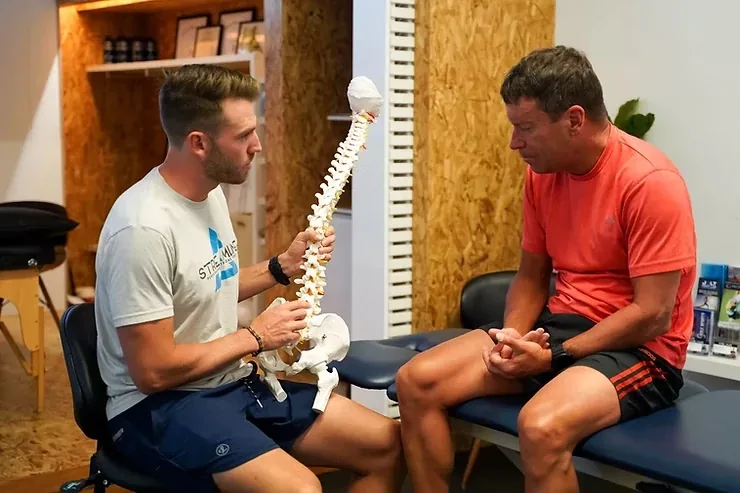
Every visit is 60 minutes, one-on-one with a Doctor of Physical Therapy. The cause-first evaluation watches you bend, sit, stand and lift, then tests segment by segment. Hands-on treatment and the first loading start that visit, because backs rarely do well on rest alone.
Your plan has an endpoint named at the evaluation. Most people come 2 to 3 times a week for 4 to 6 weeks at minimum, with the same doctor. No referral is needed in Arizona.
What does getting better look like?
Better shows up in ordinary things first: socks without the pause, the whole sink of dishes, an unremarkable exit from the car, a ten-day flare taking three.
We track what you can hinge and carry, how long you can stand, and how long a flare runs. When those move together, you are getting better.
Left untreated, the cause changes how you sit and sleep, removes things from your week, and each flare tends to run longer than the last.
The endpoint is a back you stop thinking about, the strength to keep it that way, and a written plan for a bad week. Not a promise of never again, which nobody can honestly give.
Settle the flare without shutting you down.
Hands-on treatment, positions that ease it, and dry needling where muscle has splinted hard. We keep you moving within what your back tolerates.
Give the bend back to the joints that owe it.
Mobility above and below the lumbar spine so it stops absorbing the whole movement, joint work at restricted segments, and a hinge you can reproduce with a laundry basket in your hands.
Build a back you trust with the floor.
Progressive loading of the trunk and posterior chain against standards you clear before moving on: carries, hinges, real weight. This is where picking your kid up stops being a decision.
Make it stay fixed.
Testing before you are cleared, then a program sized to your real week. Two sessions you will do beat five you will not, and you leave knowing what to do when it grumbles.
“When I hurt my back, I started seeing Krista regularly for a couple months. She’s more than just a physical therapist, she’s a friend who really cares. I ignorantly turned a blind eye to the importance of core strength, and by working with Krista, I saw it in a new way.”Melanie S. · patient testimonial
Start with a cause-first evaluation for your back.
Put it in writing.
Five short questions. A real person calls you back, usually within two business hours, with times that fit your week.
The people who end up filling this out are rarely in the worst pain of their life. They’re just done working around it, done picking the errand that doesn’t require the stairs. If that’s the stage you’re at, this is the part where you stop researching and start.
Consider it filed.
A real person will call you back, usually within two business hours, with appointment times that fit your week. Keep your phone nearby.
Can’t wait? Call (602) 755-3138 ⟶Easy to find. Easy to park.
In the neighborhood, with parking by the door. Come see the place before you commit, if you like.
The clinic · Streamline Performance Physical Therapy
Get Directions ⟶Opens in Google Maps