

Phoenix, AZ · Services
Manual Therapy in Phoenix
Skilled hands-on treatment that shows the doctor what is stiff, guarded, or irritated, and opens enough range that your exercise afterwards has somewhere to go.

What is manual therapy in Phoenix?
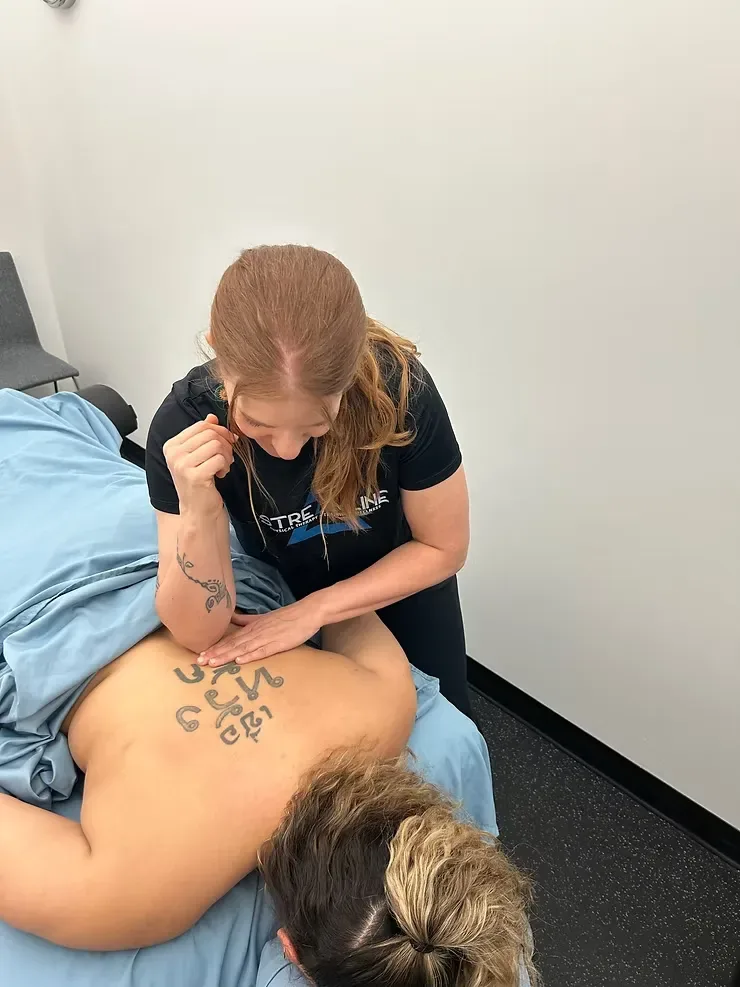
Manual therapy covers everything we do by hand: soft tissue work on protective muscle and fascia, joint mobilization to restore glide in a stiff joint, and traction or muscle energy techniques for joints that respond better to unloading.
It is also an assessment. Feeling where and how a joint stops, and whether tissue guards first, tells us what a scan cannot. Two people with identical scans can move very differently, and yours decides the treatment.
Hands-on work opens a window, and what we load into it makes the change hold, so it always sits inside a plan with a named endpoint.
What does a manual therapy session look like?
You move first, because that decides the hands-on work. Then, on the table in comfortable clothes, the clinician works segment by segment and tells you what they feel. Some of it is firm, but you should never be bracing through it.
Then we retest the same movement to see whether the technique earned its place, and you load the new range before you leave. The hands-on portion is largest at the start of a plan and smallest at the end.
Who this is for, and who it isn’t.
Good fit
- Your pain is clearly worse in one direction, one position, or after sitting still.
- One side moves measurably less than the other and has not come back on its own.
- You cannot get into the positions your prescribed exercises require.
- You are stiff after time in a brace, sling, or cast.
Not the right first stop
- Anything that looks like a medical emergency: sudden severe pain with no cause, spreading weakness or numbness, fever with severe spinal pain, or chest pain. Go to an emergency room.
- Anyone wanting an open-ended weekly hands-on appointment. Hands-on work here is dosed to a phase and then reduced on purpose.
Take the guard off.
Tissue that has guarded an area for months does not stop on request. Graded hands-on work lowers that tone enough to see what the joint is doing.
Open the range that is missing.
We mobilize the segments and tissue that measured short, then retest in the same visit. If range does not change, the restriction is elsewhere, and we say so.
Load the new range so it stays.
Range you cannot control is gone by the weekend. Strength work in the new position follows every hands-on session to make the change permanent.
Fewer hands, more of you.
As range holds on its own, the hands-on portion shrinks on purpose, until you maintain it with a short routine sized to your week.
Start with an evaluation where the assessment happens through the hands.
Put it in writing.
Five short questions. A real person calls you back, usually within two business hours, with times that fit your week.
The people who end up filling this out are rarely in the worst pain of their life. They’re just done working around it, done picking the errand that doesn’t require the stairs. If that’s the stage you’re at, this is the part where you stop researching and start.
Consider it filed.
A real person will call you back, usually within two business hours, with appointment times that fit your week. Keep your phone nearby.
Can’t wait? Call (602) 755-3138 ⟶Easy to find. Easy to park.
In the neighborhood, with parking by the door. Come see the place before you commit, if you like.
The clinic · Streamline Performance Physical Therapy
Get Directions ⟶Opens in Google Maps