

When you go get your physical exam each year (if you don’t you should), think of all the different things they do to assess your health. Height, weight, blood pressure, maybe some blood work, maybe a quick health questionnaire. One thing that isn’t commonly assessed is grip strength. In this blog I am going to go over some of the research for you and explain why grip strength can be just as important to assess for general health as these other factors.
Most of us want to live a long, healthy, fulfilling life. I assume most of you reading this blog also live a pretty active lifestyle and want that to be the case as long as possible. If you’re hoping to be that 80-year-old going for a morning walk/run and still being able to lift your grandkids high above your shoulders, then grip strength is something you should pay attention to. Research has found grip strength to influence cardiovascular health, risk of falls, risk of hip fractures, risk of hospitalizations, malnutrition, sleep, depression, cognitive impairment, quality of life and cardiovascular mortality. A recent study by Turabi et al even found that grip strength can even be used as an indicator of your rotator cuff strength. As a physical therapist who treats a lot of active individuals, I commonly see shoulder pain and rotator cuff injuries in my patients. After digging into some of the recent research, this is something I will definitely assess more often going forward.
Now you may be like me when I first started reading the research and think to yourself, how does grip strength correlate with cardiovascular health or risk of falling? Frankly, there are many factors with how this comes into play. For one, if you have a strong grip, you likely have greater overall strength than someone with a weak grip. When we grip (think of a strong handshake), we are not just using muscles in the hand or forearm; we are engaging arm, shoulder and even back muscles to some extent. When looking at the correlation between grip strength and rotator cuff strength, Turabi et al found that there was a significant increase in grip strength when improving shoulder stability. This occurred without any isolated grip work. Mortality and grip strength is something that has been researched as far back as the 80s and these studies show just how important grip strength can be as an indicator to your overall health. Forrest et al found that there was a significant difference in grip strength when looking at older individuals who reported physical limitations. People in this study who reported limitations such as getting out of a chair, leaving the home, walking, and climbing stairs all had significantly weaker grip strength than those of similar age who did not report these limitations. When we read this, it makes more sense how weaker grip strength could lead to higher risk of hip fractures (Denk et al).
Let’s analyze this snowball effect.
If you have a weaker grip, your overall strength will decrease. When your overall strength decreases, you are not as active. Fatigue sets in and all of a sudden those morning walks become less frequent, the gym visits are not happening anymore and you can’t play with your grandkids because you can’t keep up. As you continue to lose strength, your lifestyle becomes more sedentary. This can lead to loss of balance, endurance and higher risk of falls. If you do fall and you don’t have sufficient grip strength, you won’t be able to catch yourself or prevent the fall. Then the fall can lead to potential fractures, hospitalizations and in some cases, even death. We will all lose strength to some extent as we age, that is just biology, but we can minimize this loss with consistent resistance training. Wu et al found that just a 5kg (about 11 pounds) decrease in grip strength can lead to cardiovascular disease. Other research has also found correlation of grip strength with things such as depression, cognition and even sleep.
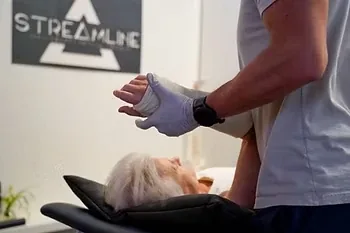
This blog is not meant to scare you and have you frantically checking your grip strength daily, but rather to inform you on another important health measure that most of us are not assessing. The good news is that there are plenty of simple ways to improve your grip strength! You can even start with something that all of us have in our homes such as a towel. There are different types of grips and different ways to target these grips with exercise, but that is a topic for another day. For now, I would encourage you to begin with some simple grip exercises such as using a stress ball, towel, or resisted grip device and hold each rep for 3-5 seconds. Check out our Youtube channel for some exercise ideas and follow us on Instagram @streamlineperformancept for future videos on this topic! Make sure that as you age, this is something that stays in your workout routine. Your future self will thank you.
References:
1) Turabi, R., Horsely, I., Birch, H. et al. Does grip strength correlate with rotator cuff strength in patients with atraumatic shoulder instability?. Bull Fac Phys Ther 27, 1 (2022). https://doi.org/10.1186/s43161-021-00059-3
2) Forrest KYZ, Williams AM, Leeds MJ, Robare JF, Bechard TJ. Patterns and correlates of grip strength in older Americans. Curr Aging Sci. 2018;11(1):63–70. doi: 10.2174/1874609810666171116164000
3) Denk K, Lennon S, Gordon S, Jaarsma RL. The association between decreased hand grip strength and hip fracture in older people: a systematic review. Exp Gerontol. In press 2018.
4) Wu Y, Wang W, Liu T, Zhang D. Association of grip strength with risk of all-cause mortality, cardiovascular diseases, and cancer in community-dwelling populations: a meta-analysis of prospective cohort studies. J Am Med Direct Assoc. 2017;18(6):551e17–551.e35.