

Phoenix, AZ · The staff
Monty Montgomery
He is a strength and conditioning coach with a powerlifting background, and he runs the small group sessions on the turf side of the building, which is where a lot of people go once a plan of care has finished.
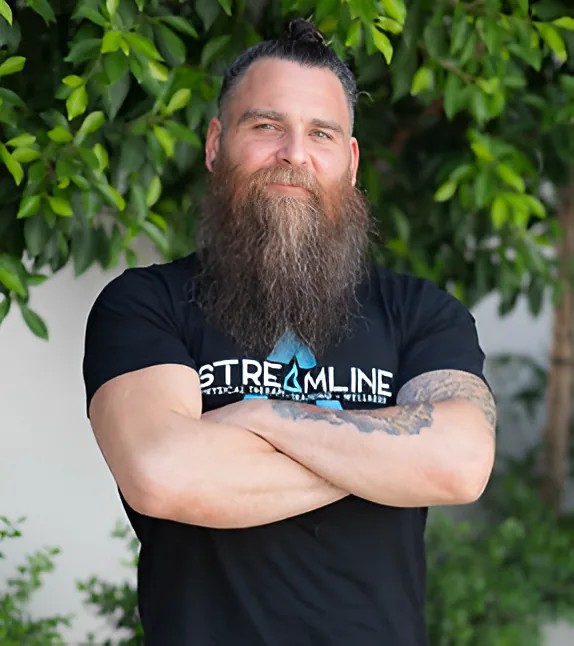
The coach on the other side of the building.
Monty Montgomery is a Strength and Conditioning Coach here. Powerlifting is his background, and it shows in how he coaches a barbell: slow, specific, and largely unbothered by how much weight is on it. Powerlifting is an unglamorous sport to come from. Three lifts, decades of small corrections, and a very long education in the difference between a bar path that works and one that gets away from you. That education transfers.
He runs the small group fitness sessions, which are not a class in the usual sense. A group is small enough that he can watch every rep, which is the only reason group training is worth doing at all: a coach who can see you is a coach who can stop the third set before it turns into a problem. People arrive at those sessions from two directions. Some come in as ordinary members who want somebody watching. Many more arrive at the end of a plan of care, when the clinical work is finished and the honest question is what happens to all that strength on the following Monday.
The people who keep what they earned in rehab are almost never the ones with the best home program. They are the ones who found somewhere to keep lifting where a coach still knew their name.
The line between his work and the clinical work is not blurred, and he is the first to say so. He does not evaluate, diagnose, or write a plan of care. He coaches strength. When someone in a group session has a symptom that needs looking at, it goes to the clinical staff, who are in the same building and usually about twenty feet away, which is a genuine advantage of this arrangement over training somewhere that has never met the person who rehabbed you.
What the coaching side actually involves.
- Small groups, watched. Sessions kept small enough that every set is seen and coached rather than counted.
- Barbell technique. Squat, press, hinge and pull, taught at the pace they are actually learned.
- Load that progresses. Adding weight on a schedule, which is the part most people skip when they train alone.
- After the plan. Somewhere to keep the strength built during a plan of care instead of watching it drain away over a season.
Where the coaching sits in the plan.
Coaching runs alongside the clinical work. It does not replace it.
Personal training
The service he runs, including the small group sessions and the one-on-one strength work.
02Sports rehab
The clinical side of returning to sport, which is where a case starts before any coaching begins.
03What we treat
If something hurts rather than just feeling weak, start here instead of on the training floor.
The role, in plain terms.
Start with the evaluation. The strength work comes after.
Put it in writing.
Five short questions. A real person calls you back, usually within two business hours, with times that fit your week.
The people who end up filling this out are rarely in the worst pain of their life. They’re just done working around it, done picking the errand that doesn’t require the stairs. If that’s the stage you’re at, this is the part where you stop researching and start.
Consider it filed.
A real person will call you back, usually within two business hours, with appointment times that fit your week. Keep your phone nearby.
Can’t wait? Call (602) 755-3138 ⟶Easy to find. Easy to park.
In the neighborhood, with parking by the door. Come see the place before you commit, if you like.
The clinic · Streamline Performance Physical Therapy
Get Directions ⟶Opens in Google Maps