

Phoenix, AZ · What we treat
Tendinitis in Phoenix
Stubborn tendon pain is usually a load problem, not inflammation waiting on rest. The tissue was asked for more than it was built for, and it recovers by being rebuilt on a schedule.
Why does tendinitis happen?
A tendon is a spring that transfers force from muscle to bone and adapts to what it is repeatedly asked to do. Trouble starts when demand outruns adaptation, usually through overuse or poor mechanics, occasionally an acute injury. Common sites: the rotator cuff with overhead work, the outside or inside of the elbow (tennis and golfer’s elbow), the wrist with gripping or typing, the patellar tendon in jumpers and the Achilles in runners.
- A change in load, not an amount of load. Tendons object to new work, not hard work: doubled mileage, an extra lifting day, a new job, a return at your old volume after a layoff.
- Speed and spring, more than weight. Stretch-and-snap loads irritate tendons most: running, jumping, throwing, sprinting, sudden stops. That is why people can squat heavy but cannot jog.
- A neighbouring joint that is not doing its share. A stiff ankle sends work into the Achilles; a hip that will not extend overloads the hamstring tendon. The painful tendon is often covering for a stiffer joint.
- Rest, repeated. Each round of stopping settles symptoms and lowers the ceiling. After three or four laps of rest, return and flare, the tendon has far less capacity and you have far less confidence.
- A tissue that adapts on a slower clock than the muscle attached to it. Muscle responds to training in weeks; tendon remodels over months. A program that suits the muscle can outrun the tendon, and the gap shows up as pain where force concentrates.
So the treatment is not ultrasound and rest. It is a controlled, progressive, uncomfortable-but-tolerable dose of the very thing the tendon has been avoiding, at a pace it can keep up with.
How tendinitis actually gets described.
-
Usuallythat warm-up pattern is close to a signature: pain at the start, quiet in the middle, an ache hours later. That is an overloaded tendon, not a damaged one.
Why does this happen ⟶ -
Usuallyrest removes the pain, not the problem. The tendon detrains while it waits, so the first week back at your old load brings it all back.
Why does this happen ⟶ -
Usuallytendons report late. The useful measure is how it feels twenty four hours after a session, so we build the program around the next-day response.
Why does this happen ⟶
Tendinitis implies inflammation, which is often true for the first few days of an acute flare. In the months-old version most people arrive with, the tissue is under-built instead, and treating it as inflammation is why this drags on.
How do we treat tendinitis in Phoenix?
The cause-first evaluation finds which tendon, how irritable it is, what changed in the eight to twelve weeks before it started, and what the joints above and below contribute. Irritability sets the starting dose more than severity does.
Then the work is loading, with hands-on treatment to make it possible. Visits are 60 minutes, one-on-one with the same Doctor of Physical Therapy, typically two to three a week for at least four to six weeks, and you almost always keep training.
What does getting better look like?
Most people here have already tried rest, ice, tablets and a strap. They want to know why none of it held, and a number to hit.
Progress is measured the next morning. The painful first ten minutes shorten, then load returns: heavier, faster, springier. Expect a flat fortnight midway; that plateau is normal.
Left alone, this narrows your week: you drop the run, then the second session, and each flare takes longer to settle. A tendon that keeps losing capacity also risks tearing.
You finish with a tendon that has room above your normal week, a short program you can progress yourself, and a plan for the first three days of any flare.
Get it back under the line.
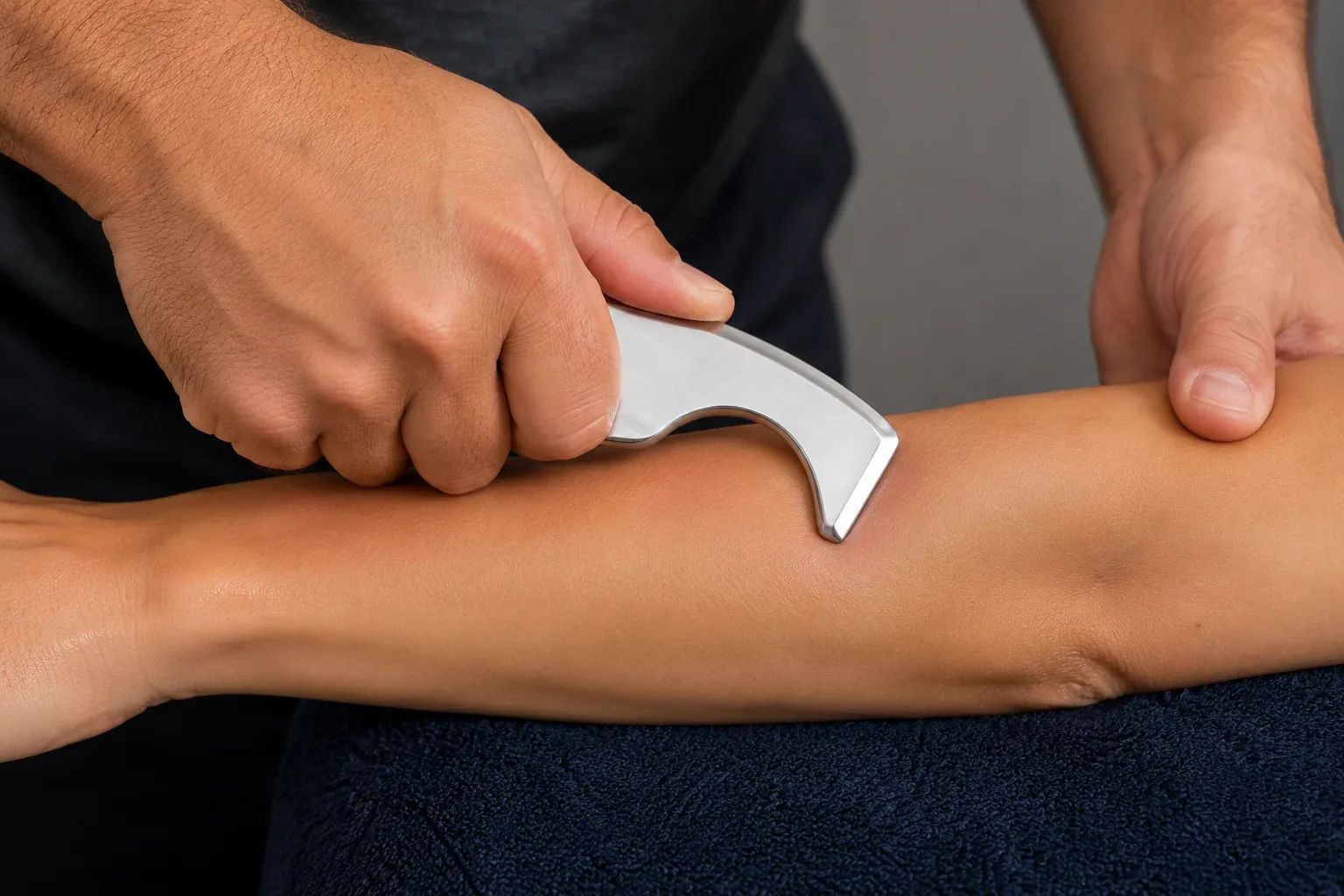
Hands-on treatment starts at the evaluation. Early loading is slow and held, which settles a cranky tendon without detraining it, and you get a next-day rule to judge each session. Heat, ice or electrical stimulation support the loading where they help.
Free up whatever is making this tendon work double.
Mobility and joint mobilization on either side, manual work to break up scar tissue and improve circulation where tissue quality limits motion, and changes to the posture, movement, ergonomics and activities that keep loading the same spot. This phase removes the reasons loading would fail.
Rebuild the tendon on a written schedule.
Heavy and slow first, including eccentric work, then faster and springier, alongside strength for the surrounding muscles and stability and coordination drills. You move up by clearing a number and a next-morning response. This phase does most of the work.
Put the ceiling comfortably above your week.
Testing before clearance, then a small, specific maintenance dose that fits your real training and survives a busy month. Tendons keep what they are asked for.
Start with a cause-first evaluation of that tendon.
Put it in writing.
Five short questions. A real person calls you back, usually within two business hours, with times that fit your week.
The people who end up filling this out are rarely in the worst pain of their life. They’re just done working around it, done picking the errand that doesn’t require the stairs. If that’s the stage you’re at, this is the part where you stop researching and start.
Consider it filed.
A real person will call you back, usually within two business hours, with appointment times that fit your week. Keep your phone nearby.
Can’t wait? Call (602) 755-3138 ⟶Easy to find. Easy to park.
In the neighborhood, with parking by the door. Come see the place before you commit, if you like.
The clinic · Streamline Performance Physical Therapy
Get Directions ⟶Opens in Google Maps