
Phoenix, AZ · Services
IASTM in Phoenix
IASTM stands for instrument-assisted soft tissue mobilisation: a clinician works through tissue with a shaped tool rather than a thumb. Here is what the term covers and which version fits you.
What is IASTM in Phoenix?
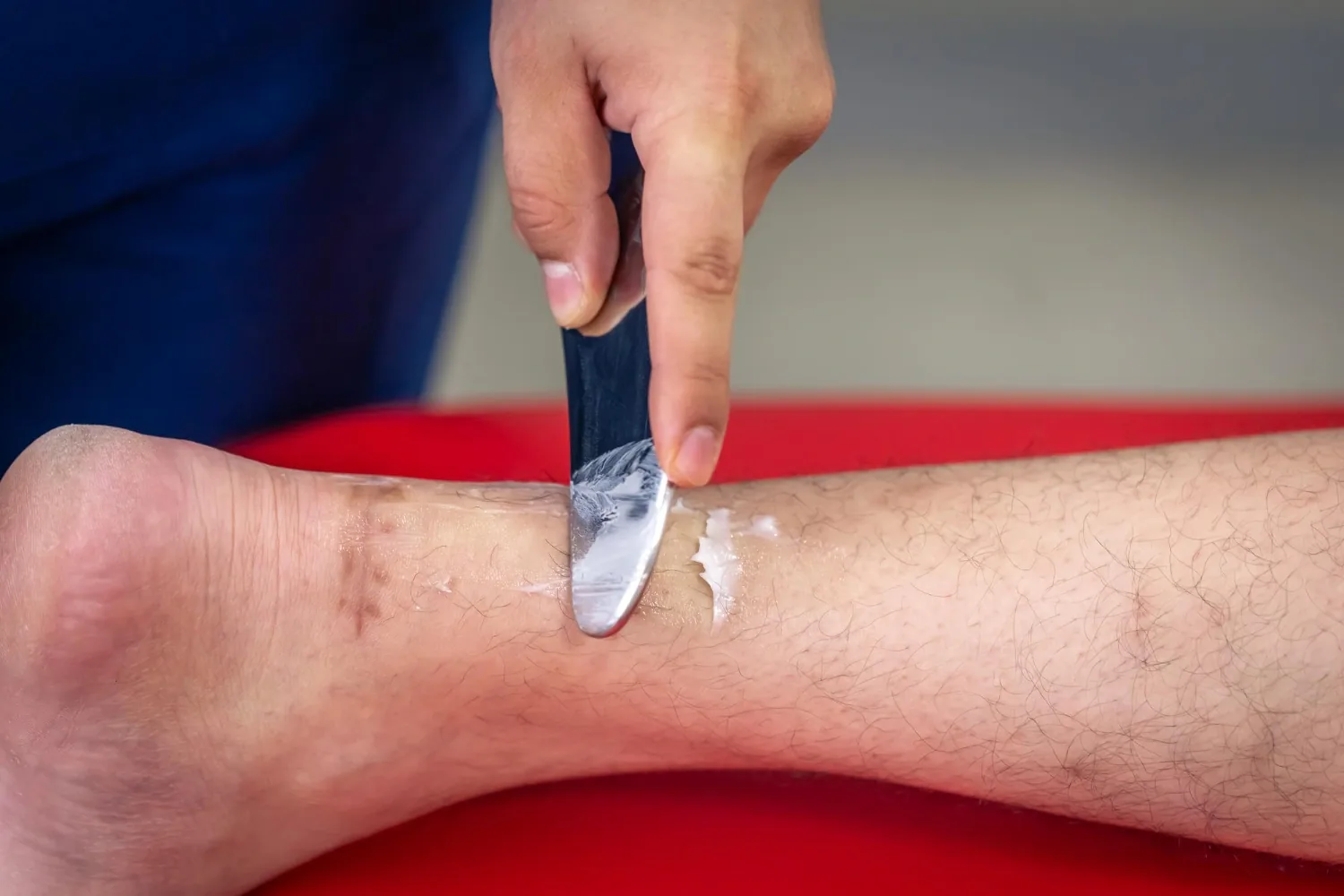
IASTM is a category, not a brand. It covers any treatment where a shaped instrument, usually steel, works across muscle, tendon, and connective tissue. Graston Technique and Astym are two named systems inside it, each with its own certification, instruments, and rules. If a clinic’s services seem to overlap, they do.
Why use a tool? A shaped edge reaches places a thumb cannot, like the seam alongside a bone, and holds even pressure across a long span. The trade-off is less fine touch, which is why much of our work stays hands-on.
The popular story that instruments break down scar tissue and adhesions is not settled science. The evidence supports something more modest: people often report less pain and better movement, likely because of how the nervous system reads sustained pressure and shear.
What does an IASTM session look like?
It starts with a screen to find what is actually limiting you, often not where it hurts. If instrument work fits, a little emollient goes on and the tool passes slowly at an angle while the clinician reads what comes back through the handle. The rough spots get the attention.
The instrument portion takes minutes. The rest of the 60 minutes with your Doctor of Physical Therapy goes to movement in the new range, loading to make it stick, and your home program. Some pinkness afterwards is expected.
Who this is for, and who it isn’t.
Good fit
- You were recommended one of these techniques by name and want to know what it is before booking.
- A tendon or muscle complaint has lasted weeks or months and rest has stopped helping.
- You want it inside a plan with a named endpoint, not an open-ended series.
- You are willing to do the loading afterwards, the half that holds.
Not the right first stop
- Signs of a medical emergency, such as chest pain, sudden one-sided weakness, a cold or numb limb, or high fever with severe pain. Go to an emergency room.
- Anyone wanting instrument work alone as a standing appointment. We do not sell the smallest part of the treatment by itself.
Decide whether a tool is the right answer at all.
The evaluation often ends with a different recommendation: hands, needles, or graded loading alone. If instrument work fits, we say which system and why, and keep the first pass short.
Put the instrument only where it changes something.
Any range the tool opens is used immediately. Mobility not put to work in the same session is usually gone by the weekend, the most common reason people say this treatment never held.
Load what was just treated.
Strength work follows in the same appointment, aimed at the treated tissue. Progression depends on clearing a standard, not on sessions completed.
Take the tool away on purpose.
Needing the tool in week six means treating a symptom. We fade it deliberately, and you finish with a program sized to your week and the endpoint set at the evaluation.
Start with the evaluation that tells you which of these you actually need.
Put it in writing.
Five short questions. A real person calls you back, usually within two business hours, with times that fit your week.
The people who end up filling this out are rarely in the worst pain of their life. They’re just done working around it, done picking the errand that doesn’t require the stairs. If that’s the stage you’re at, this is the part where you stop researching and start.
Consider it filed.
A real person will call you back, usually within two business hours, with appointment times that fit your week. Keep your phone nearby.
Can’t wait? Call (602) 755-3138 ⟶Easy to find. Easy to park.
In the neighborhood, with parking by the door. Come see the place before you commit, if you like.
The clinic · Streamline Performance Physical Therapy
Get Directions ⟶Opens in Google Maps