

Phoenix, AZ · What we treat
Elbow, Wrist and Hand Pain in Phoenix
A grip that gives out on the third set, a jar lid you pass over, a wrist that objects when you push off a desk: pain here is rarely about the sore spot, so we find what it is protecting.
Why does elbow, wrist and hand pain happen?
The forearm is long tendons doing fine work at the end of a lever. Most pain is an overloaded tendon, a nerve out of room, or a small joint braced by tired muscles; sprains, fractures and arthritis account for most of the rest.
- Tendon overload on the outside of the elbow. Most people with tennis elbow have never held a racquet. The tendon steadying your wrist attaches at the outside of the elbow and loads with every grip, and gripping harder because it hurts makes it stubborn.
- Tendon overload on the inside of the elbow. Golfer’s elbow is the flexor-side mirror image, common in anyone who grips hard and pulls: rows, deadlifts, groceries, the top of a golf swing. Dr. Lauren Mueller is TPI certified, so the swing is part of the exam.
- A nerve that has run out of room. Carpal tunnel brings numbness, tingling and dropped objects, worse at night and first thing in the morning. The nerve can be squeezed at the wrist or tethered further up, so we test where it stops sliding rather than assume.
- Wrist joints being braced instead of supported. Pushing off a desk, catching a fall, a front rack or a push-up loads the wrist near end range. Stiff carpal joints or a forearm that cannot hold position leave the joint taking load directly: a pinch at the back of the wrist.
- Grip capacity that was never rebuilt. Grip is the honest number. After a sprain, cast, layoff or heavy season it drops and does not return on its own. Dr. Nick Hadinger is a USA Weightlifting coach, so grip is measured and trained, not assumed.
What separates these is not where you point, but how symptoms change as we alter wrist position, tendon load and nerve tension one at a time. That is the difference between a brace and a plan.
What people say when the grip goes.
-
Usuallythe forearm muscles that steady the wrist have lost capacity, and grip drops once the wrist cannot be braced. The fingers are fine; the scaffolding behind them is not.
Why does this happen ⟶ -
Usuallyload through the extensor tendon where it attaches to bone, which is why a full coffee cup can hurt more than a heavy pull. Forearm position matters more than weight.
Why does this happen ⟶ -
Usuallythe median nerve is compressed or not sliding freely, and your sleeping wrist position is doing most of the work. Nerves complain about position before load.
Why does this happen ⟶
Most people here were told to rest it, and it worked until they went back. They want to know what the tissue tolerates now and how to raise that number.
How do we treat elbow, wrist and hand pain in Phoenix?
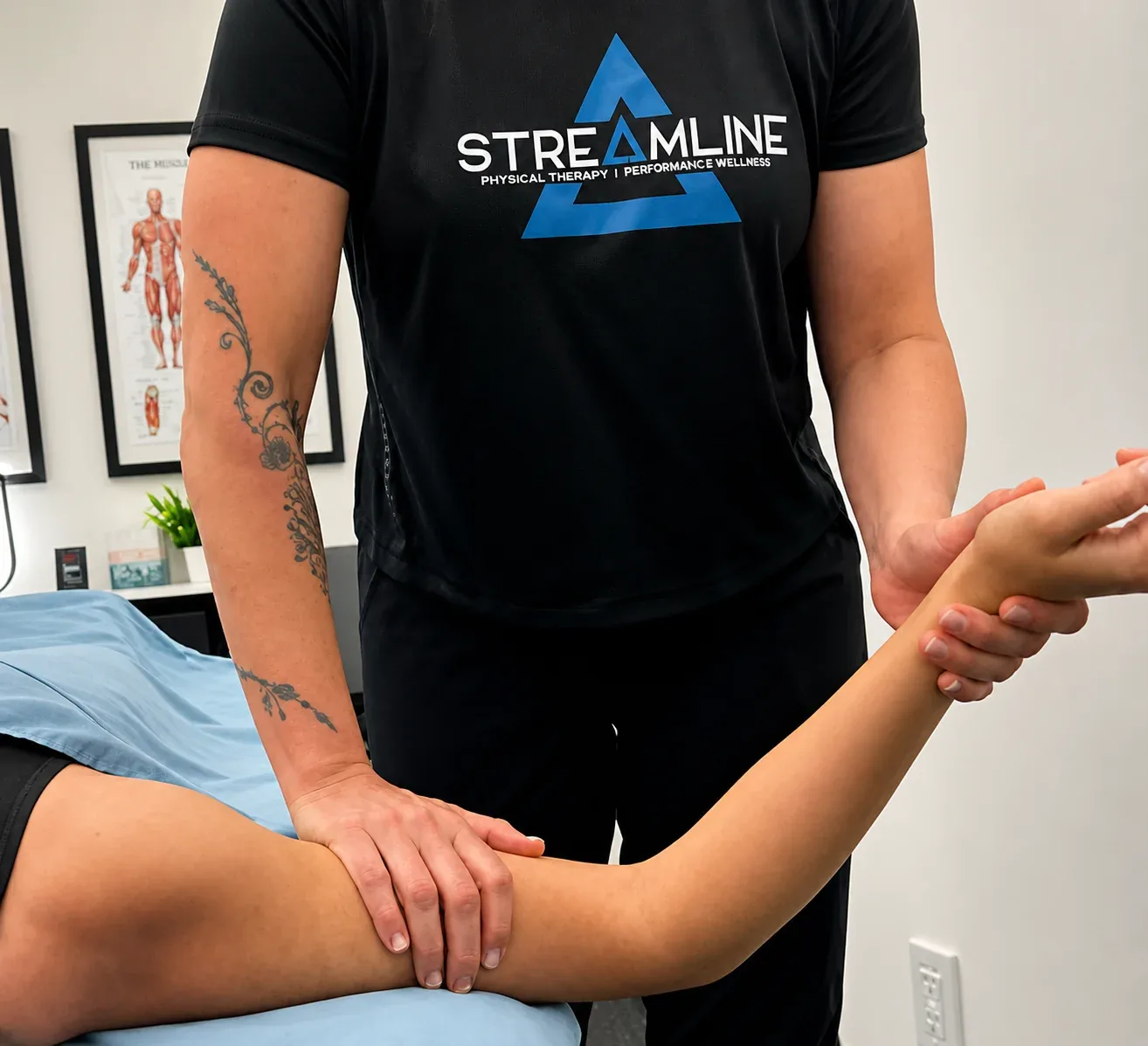
The first visit is a 60-minute, one-on-one evaluation with a Doctor of Physical Therapy: grip measured, the tendon loaded in provoking positions, nerve tension tested, circulation screened, posture and alignment checked up the arm, injury history reviewed, and how you hold the club, bar, tool or mouse observed. Hands-on treatment starts the same visit.
You see the same doctor every visit, with an endpoint named at the evaluation. No referral is needed, and we are cash-pay and do not bill insurance directly, with the rate given before you book.
What does getting better look like?
Tendons respond to load, not time. Within a couple of weeks the burning usually eases during ordinary tasks like lifting a kettle or turning a key. That is capacity returning, and it is when most people stop too early.
We keep testing grip. When the sore side comes within range of the other and holds across repeated sets, the tendon has changed. Numbness eases on a different curve: night first, then morning, then through the day.
Left alone, you grip harder, avoid provoking movements and the arm weakens, so flares come easier and last longer. Prolonged nerve compression can cause lasting damage, and stiff joints and degenerating tendons get harder to reverse.
The evaluation names the endpoint and what must be true to reach it. If symptoms point to a nerve conduction study or a surgical opinion, we will say so rather than treat around it.
Take the load off the attachment.
Hands-on forearm work, instrument-assisted soft tissue where tissue has thickened, and a short list of grips and angles to change for now. Not rest: moving where the load lands settles a tendon faster than stopping.
Get the wrist and forearm moving again.
Mobility for what actually limits you: the small wrist joints, forearm rotation you lost without noticing, and nerve glides when the nerve has stopped sliding.
Rebuild the tendon under load.
Progressive, measured tendon loading at the angle that used to hurt, with grip strength as the target. You clear a numeric standard before the load goes up.
Fix the thing that loaded it.
The grip, setup, swing or desk. Then a program sized to your week so the tendon keeps its new capacity through the off season.
Start with a cause-first evaluation for your elbow, wrist or hand.
Put it in writing.
Five short questions. A real person calls you back, usually within two business hours, with times that fit your week.
The people who end up filling this out are rarely in the worst pain of their life. They’re just done working around it, done picking the errand that doesn’t require the stairs. If that’s the stage you’re at, this is the part where you stop researching and start.
Consider it filed.
A real person will call you back, usually within two business hours, with appointment times that fit your week. Keep your phone nearby.
Can’t wait? Call (602) 755-3138 ⟶Easy to find. Easy to park.
In the neighborhood, with parking by the door. Come see the place before you commit, if you like.
The clinic · Streamline Performance Physical Therapy
Get Directions ⟶Opens in Google Maps