

Phoenix, AZ · What we treat
Headaches in Phoenix
Many stubborn headaches are referred from the upper cervical spine, so a scan can come back clean while the headache still arrives every afternoon. We look at where the pain comes from, not only where it lands.
Why do headaches happen?
Not every headache is ours, and we will say so plainly. These are the drivers we can treat.
- The top three cervical segments refer pain into the head. Nerves from the top three neck levels feed the same brainstem relay as the nerve supplying your face and forehead. The relay cannot tell them apart, so an irritated upper neck joint registers as pain above the eye, far from its source.
- Suboccipital muscles that never switch off. The small, sensor-dense muscles under the skull hold a low-grade contraction all day when your screen sits too far forward, referring pain in a band to the temple, the arc most people trace with a finger.
- Clenching, especially overnight. A jaw that grinds or braces for hours causes temple pain easily mistaken for a causeless headache. Waking with it, or with a tired jaw, is the tell, and it is treated at the jaw and neck together.
- A visual demand that never changes distance. Eight hours at one focal length holds the same eye muscles in one position, and the head creeps forward to help. Headaches that build through the afternoon and lift on a screen-free weekend usually involve this.
- Sleep, hydration and the load of the week. These set the threshold rather than cause it. The same irritated segment is silent on a well-slept week and produces a three-day headache on a bad one, so we look at what changed.
Some headaches need a physician or emergency care first: sudden and severe, with fever or a stiff neck, after a head injury, with vision loss, weakness, slurred speech or confusion, or a new pattern later in life. We are glad to work alongside that care.
How people describe the headache that keeps coming back.
-
Usuallythe classic cervicogenic headache path. The upper cervical structures share a nerve pool with the nerves supplying the forehead and eye, so the brain reads a neck problem as face pain.
Why does this happen ⟶ -
Usuallya useful clue. A headache that reliably picks one side tends to come from a one-sided structure, which is testable. Headaches that alternate sides usually belong to a different clinician.
Why does this happen ⟶ -
Usuallythe headache has become routine. Medication is your physician’s call, but treating the mechanical driver usually means needing it less. Physical therapy works alongside medication, chiropractic care and other treatment.
Why does this happen ⟶
People who book about headaches have usually been told nothing is wrong: often true of the scan, but not an answer. A cause-first evaluation can reproduce a cervicogenic headache in the clinic, the most useful thing a first visit can do.
How do we treat headaches in Phoenix?
The 60-minute, one-on-one evaluation with a Doctor of Physical Therapy aims first at reproduction: does sustained pressure on a specific upper cervical level bring on your familiar headache, then ease it? If so, we have something to treat. If not, that changes who you should see.
The plan has an endpoint, reviewed every phase, with the same doctor each visit, usually 2 to 3 times a week for 4 to 6 weeks minimum. Many feel relief in that window, with bigger change over 3 to 6 months.
What does getting better look like?
Getting better rarely means a headache switching off. Four headache days a week become two, they arrive at five instead of two, then one is mild enough to finish what you were doing. People stop rationing their evenings.
We track headache days in the last seven, usual start time, and whether pressure on the segment still reproduces it. When the third goes quiet, the first two almost always follow.
Untreated, the pattern tends to widen: the threshold drops, headache-free weeks disappear, and afternoons you planned around become afternoons you cancel.
The goal is not a promise of no more headaches. It is that the mechanical driver is gone and you know exactly what to do when one shows up.
Turn the volume down.
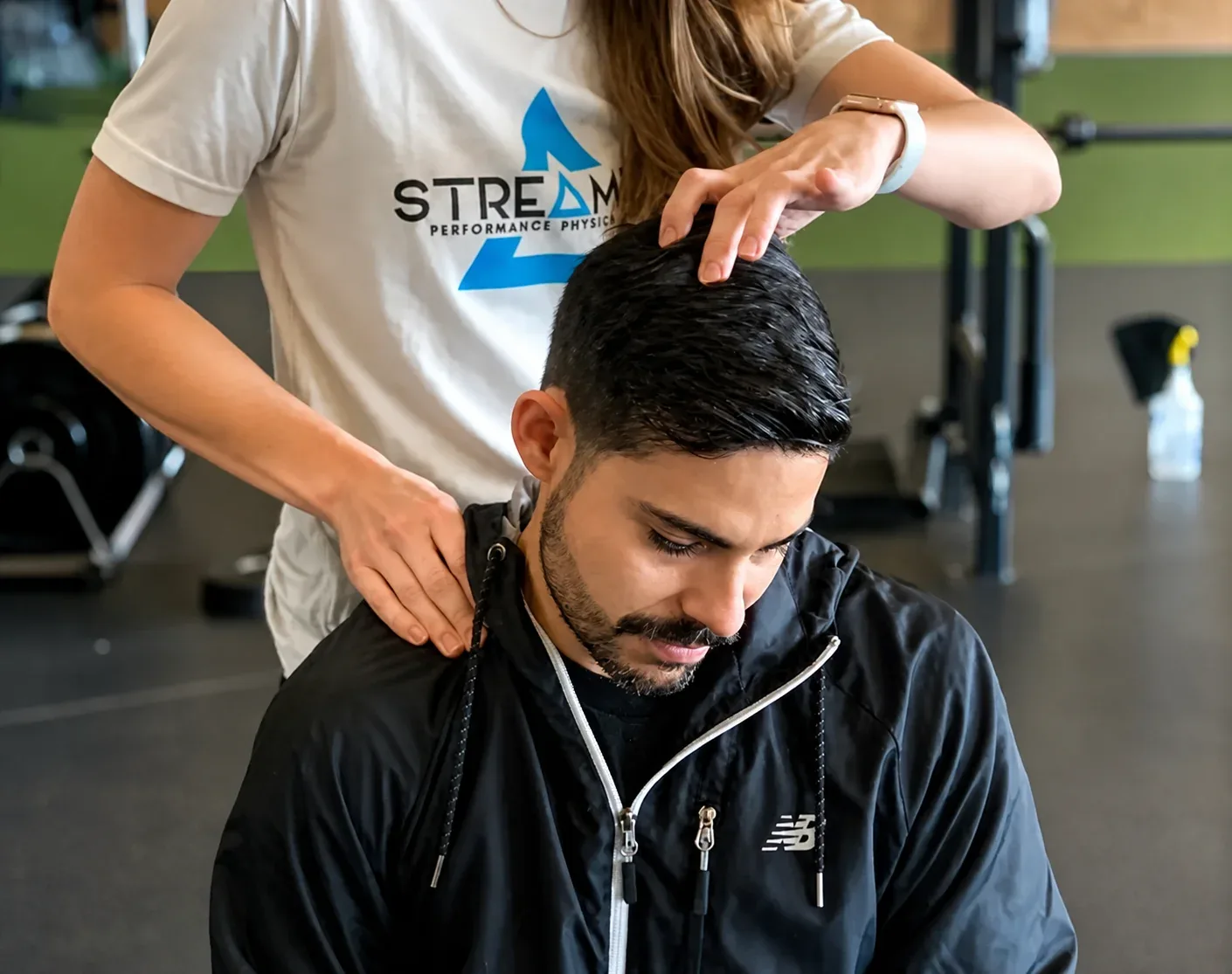
Hands-on treatment at the evaluation: sustained pressure to the upper cervical levels that reproduced your headache, suboccipital and temple muscle release, and dry needling where a muscle is driving. The aim is fewer headache days while you stay active.
Restore what the head sits on.
Mobility at the segments that tested restricted, mid-back extension so the top of the neck stops absorbing all the demand, and jaw work when clenching is involved. Everything is re-measured.
Build tolerance for the afternoon.
Endurance for the muscles that hold your head up, progressive load through the whole system, and standards cleared before moving on. Here a daily headache becomes an occasional one.
Keep the threshold high.
We review posture, screen setup, breaks, sleep and stress, then test what you kept. You leave with a short program for a real day and a written plan for when headaches try to return.
Start with a cause-first evaluation for your headaches.
Put it in writing.
Five short questions. A real person calls you back, usually within two business hours, with times that fit your week.
The people who end up filling this out are rarely in the worst pain of their life. They’re just done working around it, done picking the errand that doesn’t require the stairs. If that’s the stage you’re at, this is the part where you stop researching and start.
Consider it filed.
A real person will call you back, usually within two business hours, with appointment times that fit your week. Keep your phone nearby.
Can’t wait? Call (602) 755-3138 ⟶Easy to find. Easy to park.
In the neighborhood, with parking by the door. Come see the place before you commit, if you like.
The clinic · Streamline Performance Physical Therapy
Get Directions ⟶Opens in Google Maps